Brantford sits at roughly 248 metres above sea level, straddling the Grand River—a watercourse that has shaped more than just the city’s geography. The valley infill deposits, combined with fractured dolostone of the Lockport Formation, create subsurface conditions where water ingress and loose granular pockets are common on construction sites. Our grouting design work here has repeatedly shown that generic injection programs fail where the overburden thins abruptly or where karstic openings in the bedrock swallow grout unpredictably. For sites near the river or in the older industrial core, we often pair grouting with a piles assessment when deep foundations are unavoidable, or with in-situ permeability testing to calibrate grout mix rheology before full-scale injection begins. The goal is always the same: a design that matches the real ground, not an assumption.
A grouting design is only as reliable as the permeability data it’s built on—skip the Lugeon tests and you’re injecting blind.
Process and scope
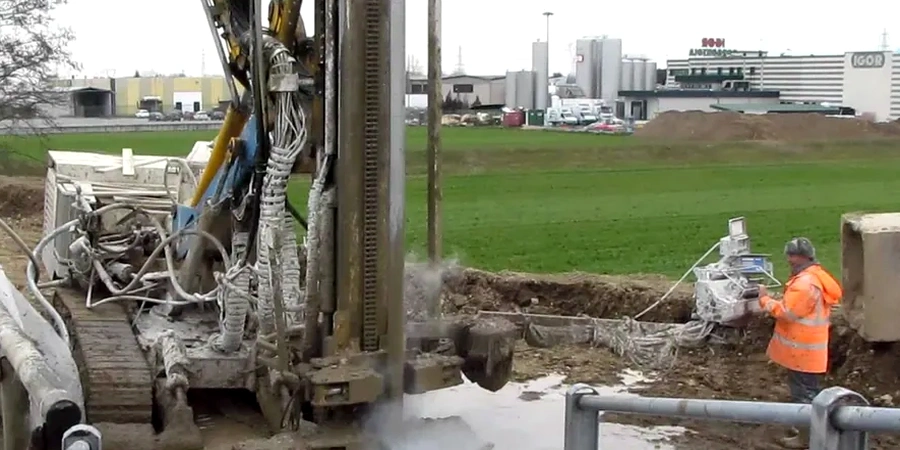
We specify grout types based on the target formation: microfine cements for medium-to-fine sands in the glacial till, and chemical or acrylate grouts where groundwater velocity exceeds 2×10⁻⁴ m/s. Jet grouting becomes the preferred method in the city’s east-end clayey silt zones, where conventional permeation grouting cannot achieve uniform bulb geometry. Every design package includes a QA/QC schedule aligned with ASTM D4320 and CSA A23.1, covering viscosity checks, bleed tests, and gel-time curves. When excavation support is part of the scope, we integrate the grouting scheme with anchors to ensure a coherent load path from the retained face into the treated ground mass.
Regional considerations
Brantford’s expansion through the mid-20th century placed residential subdivisions and light-industrial parks directly atop buried floodplain deposits and poorly documented fill. We have reviewed borehole logs from the 1960s where ‘silty sand with cobbles’ was the only description for 12 metres of section—hardly enough to design a grout curtain. The real risk on these sites is differential seepage: a grout that works perfectly in a sandy lens will bypass a cobble zone entirely, leaving a hydraulic window open. Karstic voids in the Lockport Formation add another layer of uncertainty; sudden grout loss exceeding 500 L in a single stage is not uncommon. A phased injection approach with real-time pressure-volume monitoring lets the crew adjust on the fly, and we build contingency volumes into the design from day one.
Reference standards
Applicable standards include ASTM D4320 for laboratory preparation of chemically grouted soil specimens, CSA A23.1 for concrete materials and construction methods, and ASTM D5092 for design and installation of groundwater monitoring wells.
Complementary services
Compaction and Permeation Grouting
Designed for loose granular fills and medium-dense sands in the Grand River valley. We specify stage-up injection sequences with sleeve-port pipes, using neat cement or microfine binders to densify the soil matrix and reduce hydraulic conductivity to below 1×10⁻⁵ cm/s.
Jet Grouting for Cohesive Soils
Applied in the clay-rich till units found across Brantford’s northern plateau. Our designs define jetting parameters—nozzle diameter, lift rate, and fluid pressure—to produce soilcrete columns with unconfined compressive strengths exceeding 2 MPa at 28 days.
Typical parameters
Questions and answers
What is the typical cost range for a grouting design package in Brantford?
How do you verify that the grout has filled the intended zone?
We specify real-time monitoring of injection pressure, flow rate, and cumulative volume against a pre-set refusal criteria. Post-injection verification uses core drilling at locations flagged in the design, with permeability testing (falling-head or packer tests) to confirm the target hydraulic conductivity has been reached.
Can you design grouting for groundwater cutoff under an existing building?
Yes. For occupied structures in Brantford’s downtown core, we often use low-mobility compaction grouting or angled jet grouting from the exterior. The design must account for limited headroom, vibration constraints, and the need to maintain service access, all of which we incorporate into the drilling layout and staging plan.
What grout type works best in Brantford’s fractured dolostone?
Microfine cement grouts with a maximum particle size of 12 microns perform well in the Lockport Formation’s hairline fractures. Where openings exceed 5 mm, we switch to a balanced-stable grout mix with added bentonite to control bleed and prevent runaway loss into larger karstic conduits.