The Grand River carves a distinct valley through Brantford, creating terrain that demands respect from anyone building near its edges. Many properties in the city sit on slopes composed of glacial till and silty clay deposits that behave differently depending on the season and saturation level. A proper slope stability analysis here is not just a regulatory checkbox. It is a proactive measure that identifies potential failure surfaces before excavation equipment ever arrives on site. Our geotechnical team has spent years correlating laboratory shear strength data from local triaxial tests with field observations along the river corridor from Cainsville to Eagle Place, building a database that guides conservative, practical engineering recommendations for Brantford's unique topography.
Stable slopes in Brantford depend less on textbook formulas and more on understanding how Halton Till reacts when the Grand River rises.
Process and scope
Regional considerations
Ontario Regulation 332/12 under the Building Code Act places clear obligations on designers regarding hazardous site conditions, which explicitly includes unstable slopes. Brantford's location within the physiographic region of the Haldimand Clay Plain means the near-surface stratigraphy often features a weathered crust of stiff clay over softer, more sensitive material at depth. Misjudging this profile can lead to progressive slope failures that move slowly but steadily, undermining foundations and buried utilities. A comprehensive stability analysis reads these layers correctly by combining Atterberg limits with consolidated-undrained triaxial strength data. This approach prevents the costly mistake of assuming uniform soil strength downslope. For projects near the riverbank, we also evaluate toe erosion caused by the Grand River's seasonal fluctuations, a mechanism that has triggered retrogressive failures in similar Southern Ontario settings.
Reference standards
Ontario Building Code (OBC) 2012 as amended, National Building Code of Canada (NBCC) 2020 seismic hazard provisions, CSA A23.3 for design of concrete structures, ASTM D7181 for consolidated drained triaxial compression testing of soils, and ASTM D4767 for consolidated undrained triaxial compression testing of cohesive soils.
Complementary services
Global Slope Stability Modeling
We construct 2D cross-sections using actual survey data and borehole logs to calculate the factor of safety for deep-seated rotational or translational failures. Both drained and undrained scenarios are simulated to bracket the critical case.
Groundwater Impact Assessment
Pore-water pressure is often the controlling variable in Brantford's slopes. We install piezometers and combine monitoring data with seepage analyses to quantify how changes in groundwater flow affect long-term slope stability.
Remediation and Reinforcement Design
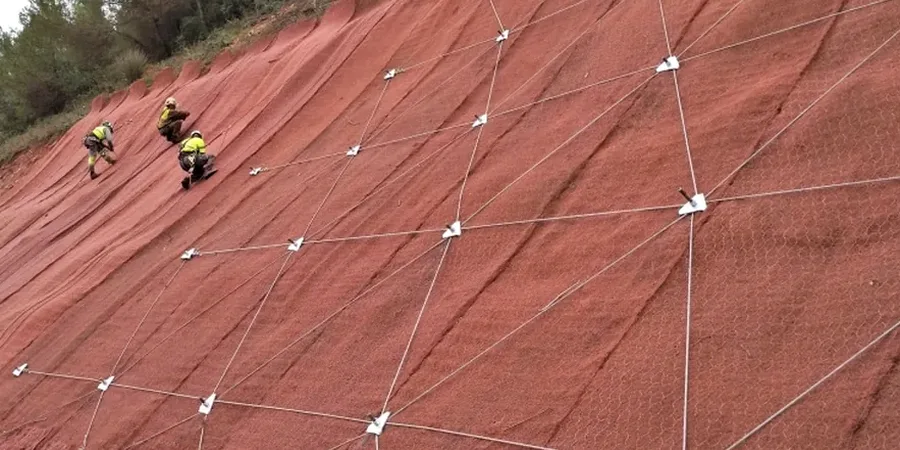
Where existing slopes show signs of distress or inadequate safety factors, we design stabilization measures. These may include regrading, drainage improvements, or structural reinforcement tied back into competent material.
Typical parameters
Questions and answers
What is the typical cost range for a slope stability analysis in Brantford?
How long does the analysis process take from field investigation to final report?
A straightforward analysis on a single-family lot can often be completed within three to four weeks after drilling is finished. Larger commercial projects involving piezometer monitoring or iterative design of retaining structures usually extend to six or eight weeks because the laboratory testing program and modeling require more back-and-forth refinement.
Do I need a slope stability study for an addition on a flat lot?
If your lot is genuinely flat and set well back from any creek or riverbank, a full stability analysis is rarely required. However, Brantford has many properties that appear level at the house but drop off significantly toward the rear lot line; in those cases, the building department may request a geotechnical letter confirming that the proposed construction will not affect or be affected by the adjacent slope.
Which laboratory tests are most critical for the analysis?
The core strength parameters come from triaxial compression testing, typically consolidated-undrained with pore-pressure measurement for cohesive soils. Direct shear tests on the granular till matrix are also common. Index testing for grain size distribution and Atterberg limits helps classify the materials and predict their drained versus undrained behavior during rapid loading events.