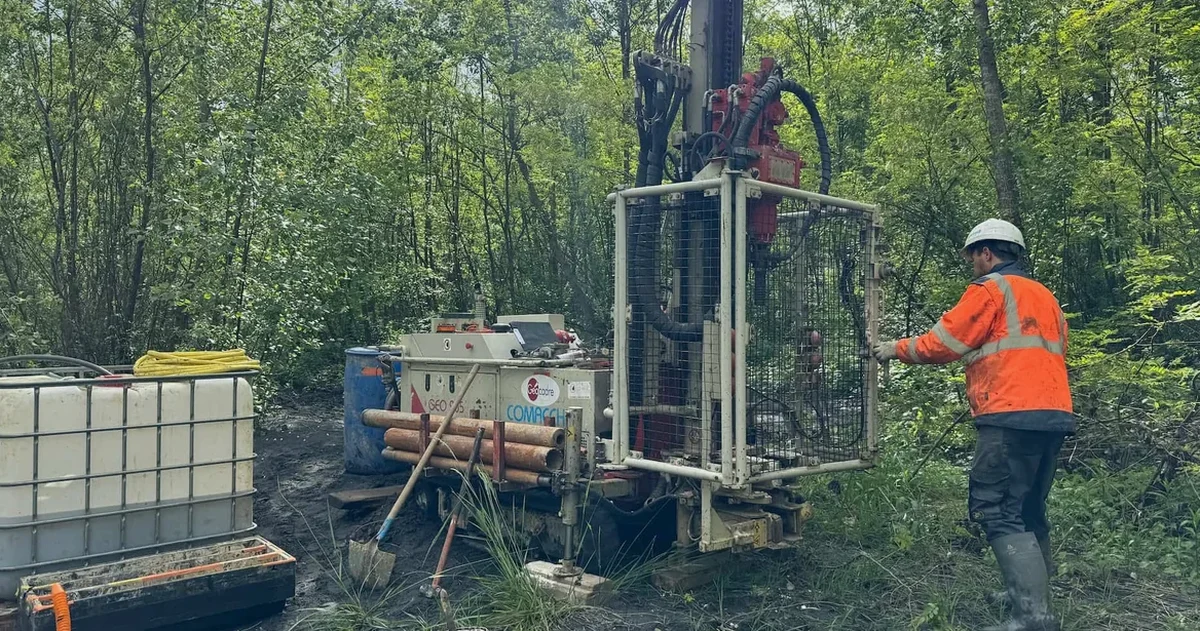
Brantford sits in a unique geological pocket along the Grand River, where the average elevation of 196 meters masks a complex subsurface of glacial till, silty clay, and occasional organics left by the ancient Lake Warren plain. We have pulled samples from sites within two kilometers of the river where the upper three meters alternated between stiff clay and loose sand lenses — exactly the kind of profile that makes a soil mechanics study non-negotiable before you pour a foundation. The 2020 National Building Code of Canada (NBCC) requires a soil mechanics study to define bearing resistance and settlement parameters for any Part 4 building, and municipalities across Brant County enforce this through permit review. When we combine rotary drilling with lab-stage triaxial testing under consolidated-undrained conditions, we isolate the effective stress parameters that govern long-term stability in these layered deposits. For shallower investigations near the Holmedale or Eagle Place neighborhoods, we often supplement boreholes with test pits to visually log fill thickness and groundwater seepage at the excavation base.
In Brantford's layered glacial soils, effective stress parameters from a triaxial test change the foundation design completely compared to total stress assumptions.
Process and scope
Regional considerations
A developer we worked with on Colborne Street West planned a four-story mixed-use building with a single-level underground parking garage. The preliminary soil mechanics study revealed a two-meter-thick lens of soft, normally consolidated silty clay at the excavation base, with an undrained shear strength barely above 40 kPa. Without a soil mechanics study, the original design called for a conventional spread footing at 2.5 meters below grade — right on top of that weak layer. The predicted total settlement exceeded 65 millimeters, with differential settlement approaching 25 millimeters across the column grid, far beyond the NBCC tolerable limit of 25 millimeters for masonry infill structures. We redesigned the foundation scheme with deeper bearing on the competent till and recommended staged excavation to avoid bottom heave. That soil mechanics study cost a fraction of what the post-construction crack repairs and tenant disruption would have run. Brantford's patchy stratigraphy, especially near the old rail corridors and filled creek beds, means that two boreholes fifty meters apart can tell completely different stories — and guessing is never cheaper than knowing.
Reference standards
The referenced geotechnical standards include the National Building Code of Canada 2020, Division B, Part 4; the ASTM D4767-11 method for the Consolidated Undrained Triaxial Compression Test; and the Canadian Foundation Engineering Manual, 4th edition.
Complementary services
Foundation Design Parameter Report
We deliver bearing resistance factors, settlement curves, and spring constants derived from triaxial and oedometer data, formatted for direct input into SAFE or S-FRAME models.
Slope Stability and Excavation Analysis
Using effective stress envelopes from your soil mechanics study, we run limit-equilibrium analyses for temporary cut slopes and permanent embankments under Brantford's seasonal groundwater fluctuations.
Construction-Phase Verification Testing
During excavation and footing prep, we perform in-situ density tests and re-check shear strength via hand shear vane to confirm the soil mechanics study assumptions hold at subgrade.
Typical parameters
Questions and answers
How much does a soil mechanics study cost for a typical Brantford residential lot?
How many boreholes does the Brantford building department require?
Under Part 4 of the Ontario Building Code, a minimum of one borehole per 200 square meters of building footprint is expected for structures on unfamiliar ground, with at least two boreholes for any building over three storeys. Brantford's plan examiners will check that the soil mechanics study coverage is sufficient for the geological variability on your lot.
What lab tests are mandatory in a soil mechanics study for a shallow foundation?
At minimum: water content, Atterberg limits, grain size distribution, and unconfined compression or triaxial shear on undisturbed samples. If the soil mechanics study identifies compressible clay, one-dimensional consolidation testing is added to compute the settlement-time curve.
Can you reuse an old soil mechanics study from a neighboring property?
Brantford's subsurface can change sharply over short distances due to infilled ravines and historic grading. A soil mechanics study from an adjacent lot may provide regional context, but the building official will almost always require site-specific boreholes and lab data to issue a permit for a new foundation.