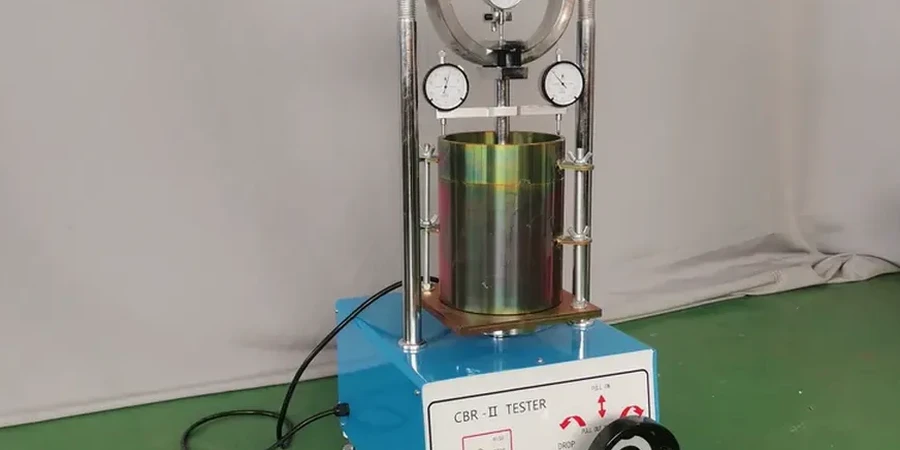
A recent arterial road reconstruction near the Brantford Municipal Airport ran into trouble when the underlying silty clay from the Grand River floodplain failed to meet the 95% modified Proctor compaction spec. The contractor was losing days to rework before our lab ran a soaked CBR series under ASTM D1883-21, revealing that the material’s bearing capacity dropped from 12% to under 4% at optimum moisture — a classic scenario in Brantford’s glaciolacustrine deposits. We recommended a 300 mm granular subbase replacement combined with chemical stabilization of the upper 150 mm of subgrade, and the section passed the next proof roll. For similar Brantford projects, pairing a Proctor test with the CBR sequence eliminates the guesswork between compaction effort and actual structural contribution. When the stratigraphy suggests variable lenses, a test pit campaign helps the lab select the worst-case remolded sample instead of relying on a single bag sample from the grading foreman.
A 4% CBR on Brantford’s glaciolacustrine clay demands either a 300 mm granular subbase or chemical stabilization — anything less and the pavement fails within three freeze-thaw seasons.
Process and scope
Regional considerations
The Ontario Ministry of Transportation’s LS-701 specification and the AASHTO 1993 pavement design guide both require a soaked CBR for subgrade characterization, and Brantford’s shallow groundwater table — often within 1.5 m of grade in the Holmedale and Eagle Place neighborhoods — makes this requirement particularly critical. A design CBR selected from an unsoaked test can overestimate subgrade strength by a factor of two or three, leading to a pavement structure that ruts and crocodile-cracks within the first two years of service. Our lab has documented soaked-to-unsoaked CBR ratios as low as 0.25 on Brantford’s brown silty clays, which means a contractor relying on a 12% unsoaked value is effectively building on a 3% subgrade. The consequence is not just premature fatigue cracking; it’s a reconstruction cost that can reach four times the original pavement budget. We run parallel specimens at three moisture contents when the field density log shows variability exceeding ±2% from the target, a step that aligns with the NBCC 2020 reference to geotechnical performance verification for municipal infrastructure.
Reference standards
Testing is conducted in accordance with ASTM D1883-21, AASHTO T 193-22, MTO LS-701, and ASTM D1557-12 (Modified Proctor companion).
Complementary services
Soaked CBR Series
Three-point compaction at 10, 30, and 65 blows per layer with 96-hour submersion, delivering the CBR-moisture curve required for MTO pavement design.
Swell Potential Measurement
Continuous swell monitoring during the soaking phase with a 0.002 mm precision dial gauge, critical for Brantford’s moisture-sensitive glaciolacustrine clays.
Unsoaked CBR for Granular Materials
Immediate penetration testing on compacted granular subbase samples per ASTM D1883, used to verify imported aggregate quality before placement.
CBR-Based Pavement Thickness Design
Structural number calculation using the AASHTO 1993 equation with lab-measured CBR input, providing the granular base and asphalt layer thicknesses for Brantford municipal roads.
Typical parameters
Questions and answers
How much does a laboratory CBR test cost in Brantford?
Why does Brantford require a four-day soaked CBR instead of a quicker unsoaked test?
Brantford’s subgrade soils — predominantly glaciolacustrine silty clays deposited by the Grand River — experience a dramatic strength loss when saturated. A soaked CBR simulates the worst-case spring-thaw condition when the water table rises and the pavement structure must perform. An unsoaked test on these materials can overestimate the design CBR by 200-300%, leading to under-designed pavement that fails prematurely under Brantford’s freeze-thaw cycling.
What sample mass do you need for a CBR test and how should it be shipped?
We require approximately 25 kg of representative material sealed in a moisture-tight container to prevent drying during transport. The sample should be taken from the subgrade elevation with a clean bucket auger or from a test pit face, and the container must be labeled with the project name, station, and depth. For Brantford projects east of the Grand River, we recommend sampling within 24 hours of excavation because the silty matrix oxidizes quickly and can alter the compaction response.
How do you determine which CBR value to use for pavement design?
We plot the CBR against the compaction moisture content for the three specimens and select the value at the field target moisture, typically within ±1% of optimum. If the field density log shows moisture variability, we report a range. For Brantford municipal roads, this soaked design CBR is then entered into the AASHTO flexible pavement equation to calculate the required structural number, which determines the granular base and asphalt thicknesses.