Many local contractors assume Brantford’s subsoil is uniform glacial till, then get caught off guard by a pressurized sand lens at depth during a basement dig. That surprise can turn a straightforward excavation into a costly dewatering and shoring emergency. The reality is the city sits on a complex stratigraphy left by the retreat of the Wisconsin ice sheet, where the Grand River carved deep channels now filled with interbedded silts, sands, and clay-rich tills. A proper geotechnical design of deep excavations here must map these lenses before shoring is installed. We combine data from CPT testing to identify thin water-bearing seams with test pits that expose the upper weathered crust, then model the lateral earth pressures specific to Brantford’s layered profile. The result is a shoring scheme that works with the ground, not against it.
Mapping the interface between the Halton Till and the underlying stratified drift is the single most critical step for any deep excavation design in Brantford.
Process and scope
Regional considerations
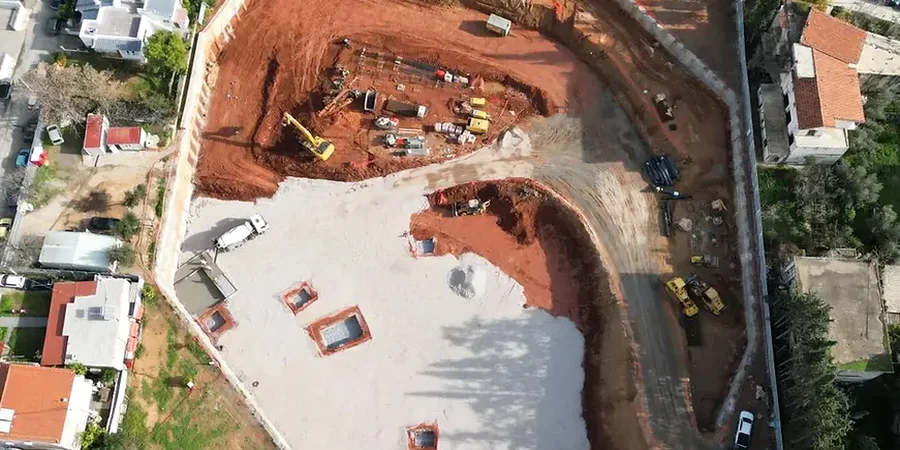
Brantford’s industrial past left a legacy of buried foundations, backfilled mill races, and undocumented fill that complicate deep excavations downtown. Early development followed the Grand River’s power, and later canal and railway projects reworked the land in ways that aren’t always captured in modern borehole databases. Encountering a 19th-century stone foundation or a pocket of hydrocarbon-impacted soil mid-excavation can halt work and require a design revision. Our team reviews historical fire insurance maps and aerial photography from the 1930s onward to flag these risks in the design phase. Where the risk of basal heave exists in soft clay pockets, the design includes a jet grout plug or a strutted base slab, calculated with a factor of safety above 1.5. Groundwater rebound after pumping shutdown is another Brantford-specific concern, particularly where the lower till acts as an aquitard; we model the recovery curve to prevent buoyancy damage to the permanent structure.
Reference standards
The National Building Code of Canada 2020 governs structural loads
Complementary services
Shoring and Berm Design
Full structural design of soldier pile and lagging, secant pile, or diaphragm walls, with staged berms analyzed for short-term stability during each lift of excavation.
Dewatering and Groundwater Modeling
Analytical and numerical groundwater flow models to size a dewatering system that handles Brantford’s sand lenses without triggering settlement of adjacent footings.
Construction-Phase Instrumentation Plan
Specification of inclinometers, piezometers, and survey points with defined alert and alarm thresholds, allowing the contractor to proceed confidently with the observational method.
Typical parameters
Questions and answers
How long does a deep excavation geotechnical design typically take for a Brantford project?
For a mid-rise development with a single-level underground parking, the design package including shoring calculations, dewatering analysis, and instrumentation specifications usually takes three to four weeks once the site investigation data is complete. Larger or more complex excavations near the river or adjacent to heritage structures may require additional time for peer review.
What’s the cost range for a geotechnical design of a deep excavation in Brantford?
Can you design an excavation support system that protects an adjacent century-old building?
Yes, that’s a common scenario in Brantford’s older neighbourhoods. We set a strict deflection criterion for the wall—often tighter than the standard 0.5% of excavation depth—and use stiff shoring elements like secant piles combined with pre-loaded rakers or tiebacks to keep ground movement within tolerable limits for brittle masonry structures.
How do you verify that the installed ground anchors meet the design assumptions?
Every production anchor undergoes a proof test to 133% of its design load, with load-extension behaviour recorded and compared to the theoretical elastic elongation. At least 5% of anchors are selected for extended creep testing when bonded in cohesive soil, following the procedures in CSA A23.3 and the Post-Tensioning Institute’s recommendations for permanent ground anchors.