Brantford sits on a glacial lake plain where the near-surface soils are typically silty clays and clayey silts of the Halton Till, often underlain by glaciolacustrine deposits. A shallow water table is common across the Grand River valley corridor, and frost penetration reaches 1.2 m under the Ontario Building Code. These three factors—cohesive soils, high moisture, and freeze-thaw cycles—make conventional spread footings a difficult proposition for larger commercial and multi-residential projects. A raft or mat foundation changes the load distribution math entirely: instead of concentrating column loads onto isolated pads, the entire footprint works as a single rigid plate. For a city with Brantford’s soil profile, that often means the difference between a buildable design and one that triggers excessive differential settlement. Our lab correlates site-specific grain size data and Atterberg limits with NBCC 2020 bearing resistance models to size the mat thickness, reinforcement layout, and subgrade preparation protocol.
A raft foundation in Brantford is not a thick slab—it is a structural system that negotiates frost heave, variable clay compressibility, and a shallow water table simultaneously.
Process and scope
Regional considerations
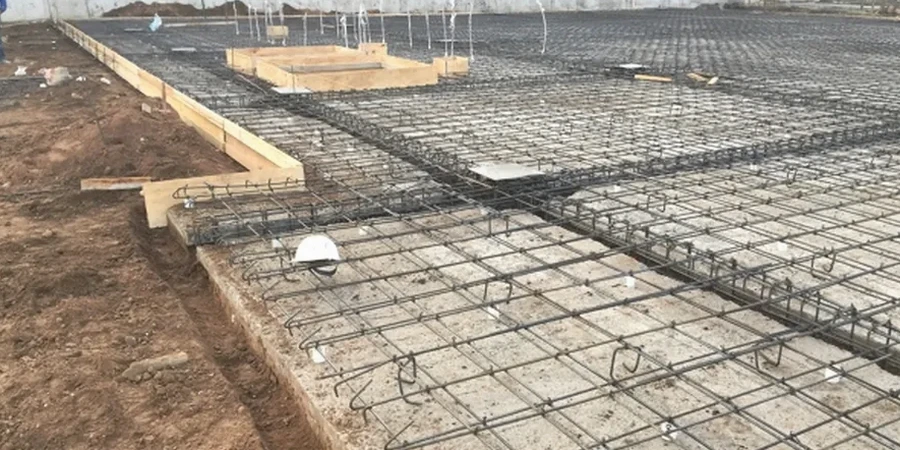
A four-storey residential project on Colborne Street excavated to bearing grade in August, when the silty clay at 1.8 m depth looked firm and dry. The structural engineer designed a 400 mm mat with top and bottom mats of 15M rebar at 300 mm centres. Construction started in November. By the time the slab was poured, the water table had rebounded to within 600 mm of the underside of the mat, and the first overnight freeze after the pour lifted the northeast corner by 8 mm. That differential movement cracked partition walls on the second floor before the building was even framed. The root cause was not the concrete mix or the rebar schedule—it was the assumption that subgrade conditions observed in August would remain stable through winter. A frost-protected raft design with rigid insulation extending 1.5 m beyond the building footprint, combined with a capillary break layer specified from the geotechnical investigation, would have prevented the edge heave entirely.
Reference standards
NBCC 2020 – Division B, Part 4 structural design and Part 9 frost protection, CSA A23.3:19 – Design of concrete structures, two-way slab provisions, ASTM D1196 – Standard test method for nonrepetitive static plate load tests of soils, OBC Supplementary Standard SB-1 – climatic and seismic data for Brantford, ASTM D2487 – Unified Soil Classification System for subgrade description
Complementary services
Geotechnical Investigation for Raft Design
Includes CPT soundings and boreholes with Shelby tube sampling to determine stratigraphy, undrained shear strength, and compressibility parameters. We deliver a kₛ profile, net allowable bearing pressure under the raft footprint, and seasonal groundwater recommendations that feed directly into the structural engineer’s SAFE or RAM Concept model.
Frost-Protected Raft Detailing and Construction Review
For heated structures on frost-susceptible soils, we specify the insulation geometry, sub-slab drainage, and perimeter edge detailing required to keep the subgrade above 0°C. This service includes pre-pour subgrade inspection, compaction verification, and reinforcement placement review against the stamped geotechnical report.
Typical parameters
Questions and answers
What does a raft/mat foundation design cost for a typical project in Brantford?
For a Brantford project, the geotechnical investigation and design package for a raft or mat foundation typically falls between CA$1,260 and CA$6,350. The range depends on building footprint size, number of boreholes or CPT soundings required, and whether seasonal groundwater monitoring is included. A single-family home with a 120 m² footprint sits at the lower end, while a mid-rise commercial building with multiple test locations and frost-protection detailing moves toward the upper end.
How do you determine the modulus of subgrade reaction for a Brantford site?
We use plate load tests following ASTM D1196 at the proposed bearing elevation, or we back-calculate kₛ from CPT cone resistance and soil behaviour type. The Brantford silty clays often show a kₛ in the range of 12 to 25 MN/m³, but relying on a textbook range without site-specific testing is risky because desiccated crust effects can inflate the near-surface stiffness while the underlying saturated clay is far more compressible.
Is a raft foundation suitable for Brantford’s frost depth requirements?
Yes, provided the design includes a frost-protection strategy. Brantford’s 1.2 m frost depth means an unheated raft can heave at the perimeter unless rigid insulation extends outward from the footing edge. For heated buildings, the thermal gradient keeps the subgrade above freezing under the interior, but the perimeter still requires insulation and drainage to prevent edge heave, per the OBC and NBCC 2020 provisions.