On Brantford’s west side near the river, we often encounter loose alluvial sands that look firm at surface but settle unevenly once a floor slab goes down. The Grand River carved through glacial outwash, leaving pockets of poorly graded sand and silt that standard compaction cannot reach below five or six meters. When a developer called us after three cone tests showed relative density below forty percent across a two-hectare industrial lot, the only practical answer was a tailored vibrocompaction design. Our approach starts with a detailed review of CPT test logs and grain-size curves, because the effectiveness of deep vibratory compaction depends squarely on fines content. In Brantford’s silty sand lenses, we often combine the CPT data with a grain-size analysis to confirm that the material falls within the compactable range before committing to a grid layout.
A well-designed vibrocompaction grid can double the CPT tip resistance in clean Brantford sands in a single shift.
Process and scope
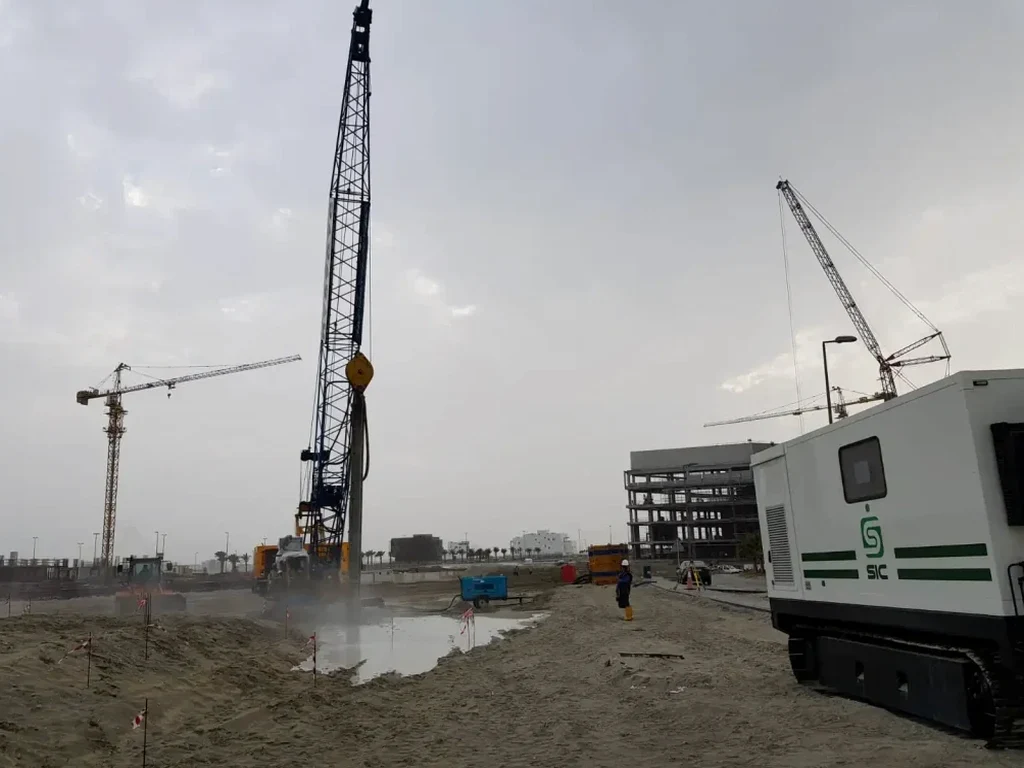
Regional considerations
A warehouse off Hardy Road showed us the cost of skipping treatment design: differential settlement cracked the slab within eighteen months, and the repair bill hit six figures before the racking could even be certified. Loose granular soils in Brantford’s river corridor densify unpredictably under cyclic loading—truck traffic, pump vibrations, even seasonal water table swings. A vibrocompaction design that ignores the transition zones between clean sand and silty lenses will leave soft spots that show up as settlement bowls later. The other risk is over-treatment: too tight a grid wastes money and can heave adjacent footings if not sequenced properly. We always tie the design to a liquefaction screening when the site falls within the NBCC seismic category, because Brantford’s moderate seismicity plus loose saturated sand is a textbook liquefaction scenario.
Video overview
Reference standards
ASTM D6066-11: Standard Practice for Determining the Normalized Penetration Resistance of Sands for Evaluation of Liquefaction Potential, NBCC 2020 Part 4: Structural Design – Seismic provisions, CSA A23.3: Design of Concrete Structures – Foundation provisions, ASTM D5778-20: Standard Test Method for Electronic Friction Cone and Piezocone Penetration Testing of Soils
Complementary services
Feasibility Assessment and Desktop Study
Review existing CPT, SPT, and grain-size data to confirm vibrocompaction suitability. We map fines content, water table depth, and depth-to-refusal across the site before recommending a trial program.
Production Design and Grid Layout
Detailed spacing, penetration depth, and pass sequence plans. Includes stone column fallback zones for silty pockets and settlement estimates under design loads.
QA/QC Monitoring and Post-Treatment Verification
Real-time rig instrumentation review, post-compaction CPT campaign design, and final sign-off report correlating measured improvement with design targets.
Typical parameters
Questions and answers
How much does a vibrocompaction design for a typical Brantford commercial site cost?
Design fees generally run from CA$1,960 to CA$8,120 depending on site size, number of CPTs to analyze, and whether a trial compaction zone is included. A half-acre commercial lot with existing CPT data sits at the lower end; a multi-acre industrial site requiring a full trial program and post-treatment verification campaign moves toward the upper end.
What soil conditions in Brantford make vibrocompaction the right choice?
Clean to slightly silty sands with less than fifteen percent passing the No. 200 sieve are ideal. Much of Brantford’s industrial land sits on glacial outwash with these characteristics. When fines content climbs above fifteen percent or clay layers are interbedded, we usually shift to stone columns or a hybrid design. A CPT-based screening with grain-size confirmation tells us within a day whether vibrocompaction will work.
How do you verify that the ground actually improved after treatment?
We run cone penetration tests on at least ten percent of the treated grid points, comparing pre- and post-treatment tip resistance and friction ratio profiles. For Brantford sites, the acceptance criterion is typically a minimum relative density of seventy percent or a CPT tip resistance threshold calibrated to the site-specific grain-size curve. All results go into a signed verification report that the geotechnical engineer of record uses to close out the foundation design.