The contrast between Brantford’s west-end subdivisions near the Grand River and the industrial parks along Henry Street is more than just land use — it runs right down to the soil profile. In the older Holmedale area, contractors frequently encounter sandy loam over limestone bedrock at shallow depths, while projects on the north side of town deal with thick glaciolacustrine clay deposits that compact very differently. Both scenarios demand precise density verification, and that is where the sand cone method proves its value. ASTM D1556 gives us a field-measured dry density that we compare directly against the Proctor maximum from the lab — a simple ratio that tells you whether the lift will perform or fail. Combined with Proctor testing to establish the reference curve, this approach takes the guesswork out of compaction acceptance on Brantford sites.
In Brantford’s variable glacial terrain, a 2% drop below Proctor maximum can mean the difference between a stable subgrade and one that settles within the first freeze-thaw cycle.
Process and scope
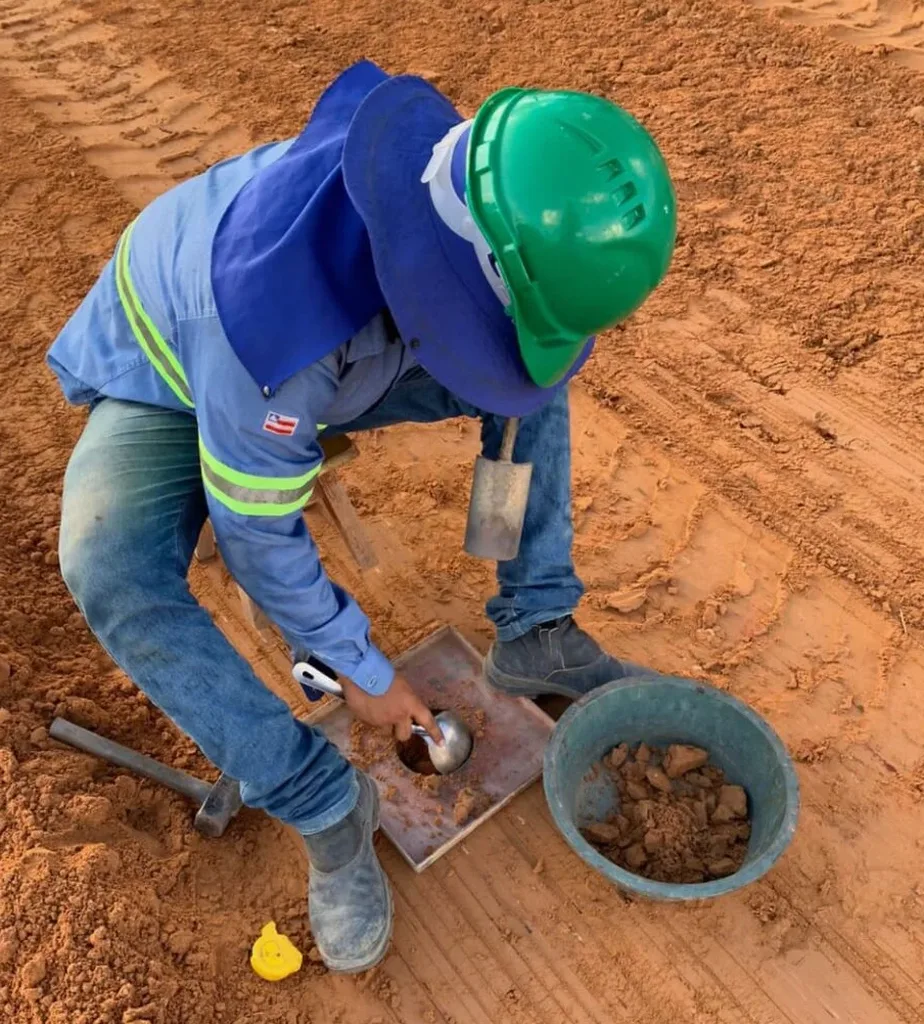
Regional considerations
Brantford’s urban development accelerated after the Grand River Navigation Company opened the canal in the 1840s, leaving a legacy of backfilled mill races, buried foundations, and uncontrolled fill in the downtown core. Later expansion onto the Norfolk sand plain introduced its own challenges — loose aeolian sands that densify poorly unless moisture-conditioned. The geotechnical risk is rarely dramatic collapse; it is the slow, differential settlement that cracks partition walls and tilts floor slabs. A single substandard lift compacted at 88% relative density can trigger callbacks two years later. The sand cone test catches these problems during construction, not after. On a recent Brantford school addition, our density readings flagged three consecutive lifts that were passing nuclear gauge checks but failing sand cone verification — the discrepancy traced to organic silt lenses that the indirect method could not resolve.
Reference standards
ASTM D1556-15: Standard Test Method for Density and Unit Weight of Soil in Place by Sand-Cone Method, ASTM D1557-12: Standard Test Methods for Laboratory Compaction Characteristics of Soil Using Modified Effort, AASHTO T-191: Density of Soil In-Place by the Sand-Cone Method, CSA A23.3: Design of Concrete Structures (referenced for foundation subgrade requirements)
Complementary services
Sand Cone Density Testing (ASTM D1556)
Direct in-place density measurement on compacted lifts for building pads, utility trenches, road subgrades, and retaining wall backfill across Brantford.
Modified Proctor Compaction (ASTM D1557)
Laboratory determination of maximum dry density and optimum moisture content using the modified effort — the reference curve for all field density acceptance.
Compaction Verification Reports
Stamped field reports with test locations on site plans, relative compaction calculations, and pass/fail summaries for municipal and consulting engineer review.
Typical parameters
Questions and answers
What does a field density test cost in Brantford with the sand cone method?
For Brantford projects, a single sand cone test typically ranges from CA$140 to CA$210, depending on site access, number of tests per mobilization, and whether laboratory Proctor data already exists. Mobile projects with multiple test locations on the same day usually fall at the lower end of that range.
How long does a sand cone test take on site?
One test — from excavating the hole through weighing and volume measurement — takes roughly 20 to 30 minutes in typical Brantford soils. If we are running a series on the same lift, the rhythm picks up and we can complete four or five tests per hour. Clay soils take a little longer because trimming the hole walls cleanly requires more care.
Can the sand cone method be used on coarse granular fill?
Yes, with caveats. ASTM D1556 is suitable for soils with maximum particle size up to about 50 mm. When Brantford sites use crushed limestone or recycled concrete with larger stones, we apply the oversize correction per ASTM D4718 or switch to a large-scale replacement method. The key is that the test hole volume must be at least 20 times the nominal maximum particle size.
Why would a sand cone test fail when a nuclear gauge passes?
The nuclear gauge measures density indirectly through gamma radiation attenuation and averages over a sensor path — it can miss thin loose lenses, organic seams, or moisture anomalies. The sand cone measures a discrete volume directly. In stratified Brantford fills, we have seen the gauge overestimate density by 3 to 5 percent in silty layers, which is why many consulting engineers specify the sand cone as the referee method for conflict resolution.