When we review site plans near the Grand River floodplain in Brantford, the first thing we check is the valley terrace stratigraphy. The city sits on a complex mix of glacial till, lacustrine silts, and sandy outwash deposits that behave very differently under lateral earth pressure. A retaining wall that looks fine on paper can develop a tilt within two seasons if the base soil softens at the contact zone. Our team runs a full geotechnical characterization before a single design parameter is set, combining field investigation with laboratory strength testing to build a soil model that reflects actual conditions. For projects where the wall footprint crosses the interface between native till and fill, we often recommend a slope stability analysis to rule out deep-seated failure surfaces extending beyond the wall backfill zone.
A retaining wall is only as reliable as the drainage aggregate placed behind it: hydrostatic pressure can double the active thrust on the stem within hours of a heavy rain event.
Process and scope
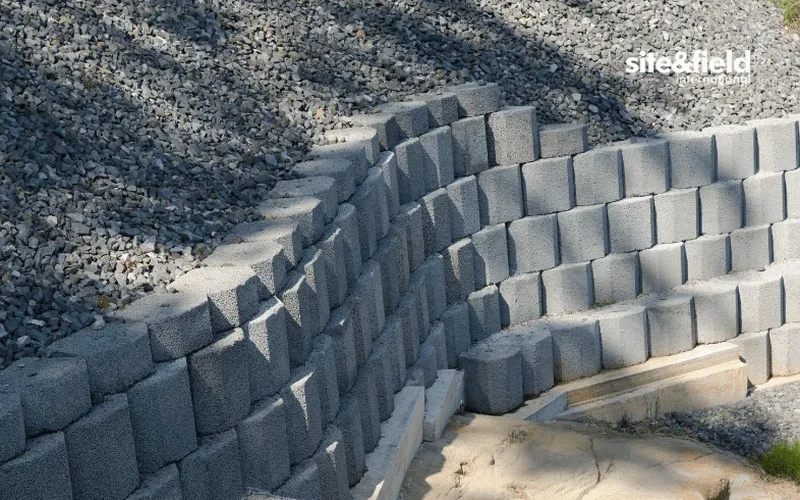
The design workflow we follow at our accredited lab integrates four distinct analyses: external stability against sliding and overturning, bearing capacity under the eccentric load, global slope stability of the retained soil mass, and internal structural design of the stem and base slab. For taller walls exceeding 3.5 meters, we model the soil-structure interaction using finite element software that accounts for staged construction and compaction-induced lateral stresses. The result is a set of construction drawings and a geotechnical design report that meets the Ontario Building Code requirements and CSA A23.3 provisions for structural concrete. Every report includes clear recommendations for backfill material specification, drainage system layout, and compaction control, because we have seen too many walls fail from water trapped behind the stem rather than from inadequate reinforcement.
Regional considerations
The most common mistake we see in Brantford is builders treating every site like a textbook case with a single friction angle and a generic backfill specification. The city's soil profile changes dramatically within short distances: a lot on Colborne Street might sit on dense sandy till with excellent drainage, while a property two hundred meters south near the river encounters soft compressible silt that loses strength when saturated. Contractors who skip the site-specific investigation often undersize the footing width, resulting in differential settlement that cracks the wall face within the first year. Another frequent problem is the omission of a proper drainage system behind the stem. In Brantford's climate, where spring melt and summer thunderstorms can saturate the ground rapidly, a wall without a continuous granular drain and weep holes becomes a dam. The hydrostatic pressure buildup can push the wall outward or cause the backfill to pipe through joints, undermining the pavement or landscaping above. Our post-failure forensic investigations consistently trace these problems back to decisions made before the first shovel went into the ground.
Video overview
Reference standards
NBCC 2020 (National Building Code of Canada, Part 4), Ontario Building Code O.Reg. 332/12 (amended), CSA A23.3:19 (Design of Concrete Structures), CFEM 2006 (Canadian Foundation Engineering Manual, 4th Ed.), ASTM D4767 (Consolidated Undrained Triaxial)
Complementary services
Geotechnical Site Investigation
Drilling and test pitting to characterize soil stratigraphy, recover undisturbed samples, and measure groundwater levels across the wall footprint, providing the input data for all subsequent design calculations.
Laboratory Strength Testing
Triaxial compression, direct shear, and consolidation testing on foundation and backfill soils to determine effective stress parameters and compressibility under the wall loading.
Wall Type Selection and Stability Analysis
Comparative evaluation of gravity, cantilever, counterfort, and mechanically stabilized earth options using limit equilibrium and numerical methods, with detailed checks for sliding, overturning, bearing, and global stability.
Construction Documentation and Inspection
Preparation of stamped design drawings, technical specifications for backfill and drainage, and on-site verification during key stages including footing subgrade approval and compaction testing.
Typical parameters
Questions and answers
How much does a retaining wall design in Brantford typically cost?
For a standard retaining wall design in Brantford, including the geotechnical investigation, laboratory testing, and the stamped engineering report, costs generally range from CA$1,240 to CA$5,420. The final figure depends on the wall height, the number of boreholes or test pits required, and whether additional analyses like global slope stability or liquefaction screening are needed. Taller walls over 3.5 meters and sites with variable soil conditions fall toward the upper end of that range.
What is the difference between a gravity wall and a cantilever wall, and how do I choose?
A gravity wall relies on its own mass to resist lateral earth pressure and works well for heights up to about 2.5 to 3 meters when space and good-quality fill are available. A cantilever wall uses a reinforced concrete stem and base slab, with the soil weight above the heel contributing to stability, making it more economical for taller walls and tighter sites. The choice depends on the soil bearing capacity at the footing level, the available right-of-way, and the height of retained material. We run both configurations through our stability model and present the comparative cost and performance data so the decision is based on numbers, not guesswork.
Do I need a building permit for a retaining wall in Brantford?
Under the Ontario Building Code, retaining walls exceeding 1.0 meter in height generally require a building permit, and walls over 3.0 meters must be designed by a professional engineer. In Brantford, the municipal building department also reviews walls near property lines and public rights-of-way. Our design package includes the stamped drawings and geotechnical report that the city requires for permit submission, and we coordinate directly with the building official when additional clarification is needed.