Brantford sits at roughly 196 m elevation on the banks of the Grand River, and the 4.7-magnitude 1998 Pymatuning earthquake reminded Ontario that moderate shaking travels far through the Great Lakes basin. With 105,000 people and a growing mid-rise inventory downtown, base isolation seismic design has moved from research paper to practical necessity here. The NBCC 2020 places the city in a moderate seismic zone, but what really drives isolation decisions is the soil column: 12 to 25 m of glaciolacustrine silts and clays over limestone bedrock, a profile that amplifies short-period motion. Our laboratory runs the cyclic shear and stability tests that feed isolator selection, so the bearing performs when the ground moves. For sites where the glacial till is thinner near the river, we often pair isolation analysis with a seismic microzonation campaign to map impedance contrasts before finalizing the design spectrum.
An elastomeric isolator is only as reliable as the soil stiffness it sits on. If the subgrade stiffness isn't characterized to ±15%, the isolator period shifts and the superstructure acceleration can double.
Process and scope
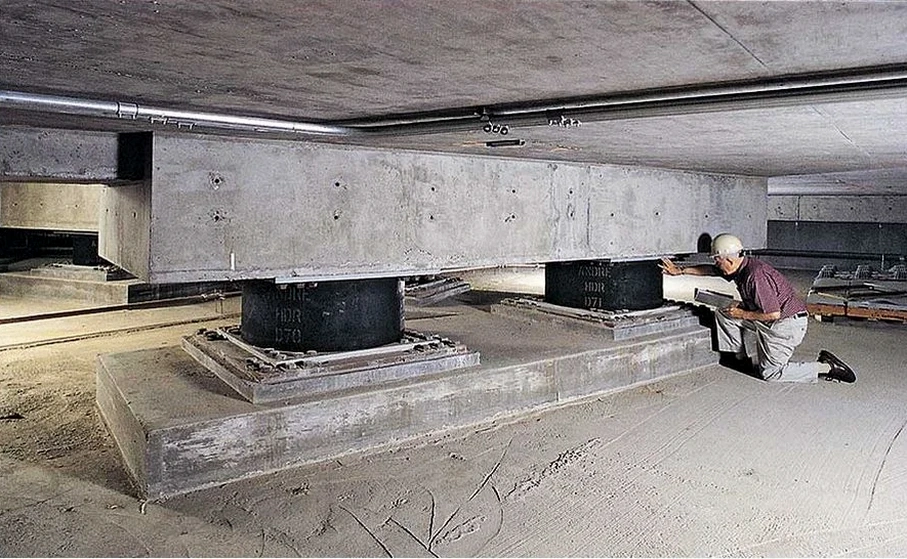
Regional considerations
The primary risk in Brantford is not high peak acceleration but the amplification of 0.5–1.5-second spectral ordinates by the glaciolacustrine clay. When a fixed-base structure has a fundamental period in that band and the isolation system is tuned too stiff, the isolators transmit more force than the superstructure can handle. We have also seen projects where the geotechnical investigation stopped at 10 m and missed a soft clay lens at 16 m; the resulting Vs profile was too fast, the isolator period was too short, and the drift estimates were off by 30%. A second risk is moat wall clearance. If the displacement demand is underestimated because soil-structure interaction was ignored, the building can pound against the retaining wall. Our protocol always includes a sensitivity run with upper- and lower-bound shear-wave velocities to bracket the bearing displacement before procurement.
Reference standards
NBCC 2020 seismic provisions, CSA A23.3-19 concrete anchorage of isolator units, ASTM D4015-21 resonant-column and torsional-shear for modulus and damping, ASCE/SEI 7-22 Chapter 17 seismic isolation requirements
Complementary services
Dynamic soil characterization for isolator modeling
Resonant-column and cyclic triaxial tests on undisturbed samples from the bearing elevation. We deliver shear modulus degradation curves and damping ratios from 10⁻⁴ to 1% strain, formatted for direct input into ETABS or SAP2000 link elements.
Site-specific response spectra and Vs profiling
MASW or seismic refraction to measure Vs30 and deeper velocity contrasts. Combined with borehole data, we produce a site-specific design spectrum that often reduces the NBCC generic envelope by capturing the real impedance structure.
Bearing subgrade stiffness verification
Plate-load or pressuremeter tests at the isolator pedestal elevation to confirm the modulus of subgrade reaction used in the foundation design. A mismatch here changes the effective isolation period, so we test at the actual bearing pressure.
Typical parameters
Questions and answers
What does base isolation seismic design cost for a typical Brantford mid-rise?
For a four-to-six-storey structure, the combined geotechnical investigation, dynamic laboratory testing, and isolator design report typically runs between CA$6,180 and CA$10,120. The spread depends on the number of borings, the depth to competent bearing stratum, and how many cyclic tests the isolator configuration requires.
Which NBCC site class applies to most Brantford properties?
It varies block by block. Areas along the Grand River with deep glaciolacustrine clay often fall into site class D or E, while the limestone bedrock outcrops on the west side push sites into class C. We always measure Vs30 directly rather than relying on the 30-metre average from a regional map, because the difference can shift the design spectrum by a full PGA band.
How do you confirm the isolator will perform under the actual soil conditions?
We extract undisturbed samples at the bearing level, run strain-controlled cyclic tests up to 150% shear strain per ASTM D4015, and generate the backbone curve and damping loop. Those curves go into a time-history model with the site-specific accelerogram. The isolator manufacturer then validates the force-displacement response against our soil-stiffness bounds, ensuring the prototype bearing matches the design assumptions before production.