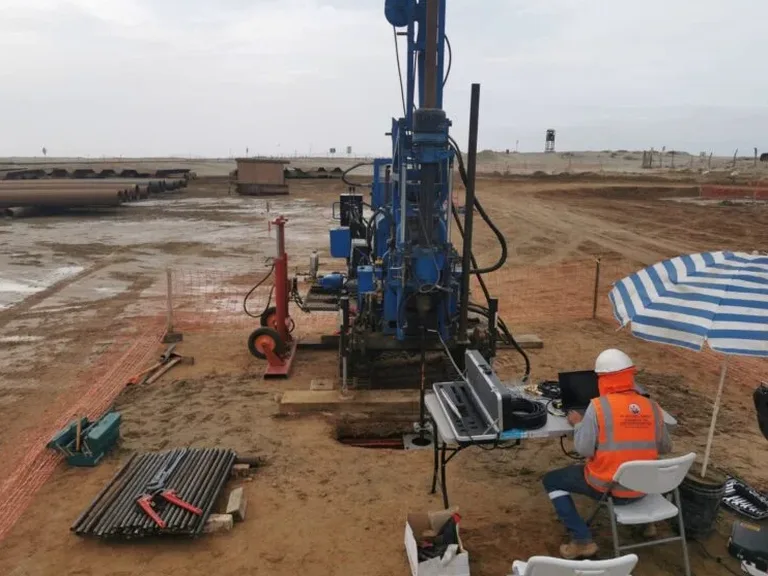
The Grand River carved a complex geological story beneath Brantford, leaving behind layered deposits that shift from dense glacial till to soft alluvial silts within a few hundred meters. Contractors who assume uniform bearing capacity across a site here often learn an expensive lesson—one that a proper cone penetration test could have prevented. CPT testing cuts through the guesswork by measuring tip resistance and sleeve friction continuously with depth, generating real-time stratigraphic profiles that standard drilling simply cannot match. In a city where the water table sits high and the Halton Till meets lacustrine clays, the precision of a triaxial shear test combined with CPT data gives geotechnical engineers the parameters they need to design foundations that last. We mobilize tracked CPT rigs throughout Brantford, from the industrial subdivisions near the 403 to the residential expansions pushing into the west end, delivering ASTM D5778-compliant results within 48 hours of field work.
Continuous CPT data reveals thin sand lenses that SPT blow counts miss entirely—and those lenses dictate drainage behavior during construction dewatering.
Process and scope
Regional considerations
A site in Echo Place near the old river oxbow can behave nothing like a lot up in Brier Park on the till plain, and treating them the same invites differential settlement. The risk intensifies in Brantford's northeast quadrant where soft, compressible organic silts accumulated in former marsh zones before the city expanded. A CPT trace through these deposits typically shows a sharp drop in cone resistance below 0.5 MPa with elevated friction ratios above 4%, signaling high plasticity clays that will consolidate slowly under structural loads. Contractors who skip the cone penetration test and rely solely on a few boreholes often miss these transitions entirely, setting up foundation elements that bridge two radically different stiffness regimes. The cost to underpin a settled structure later dwarfs the investment in proper site characterization. Our reports flag every problematic interval with excess pore pressure ratios and normalized soil behavior type, giving the design team a clear map of where ground improvement or deep foundations become necessary.
Reference standards
ASTM D5778-20 (Standard Test Method for Electronic Friction Cone and Piezocone Penetration Testing of Soils), NBCC 2020 (seismic site classification using shear wave velocity derived from CPT correlations), Robertson & Cabal (2015) Guide to Cone Penetration Testing, 6th Edition, CSA A23.3-19 for foundation design input parameters
Complementary services
Piezocone CPTu with Pore Pressure Dissipation
Our standard CPTu deployment uses a 15 cm² cone with u2 pore pressure transducer. We run dissipation tests at specified depths by halting penetration and recording the decay curve, which yields the coefficient of consolidation for each clay layer. This directly informs settlement rate predictions without the need for laboratory consolidation testing.
Seismic CPT (SCPT) for Vs Profiling
For projects requiring NBCC 2020 site class determination, we add a geophone module to the cone string. A shear wave source at surface generates signals recorded at 0.5 m intervals during paused penetration, producing a high-resolution Vs profile. The data feeds directly into site-specific response spectra and liquefaction triggering analyses.
Typical parameters
Questions and answers
What depth can a CPT rig reach in Brantford's soils?
Most Brantford sites allow penetration to 20–25 meters with a standard 20-tonne tracked rig before encountering refusal on dense Halton Till or bedrock. When the till is heavily overconsolidated, refusal may occur shallower, around 12–18 meters. We can deploy a heavier 30-tonne push system for deeper targets up to 40 meters where site access permits.
How much does a CPT test program cost in the Brantford area?
Mobilization and testing typically ranges from CA$260 to CA$310 per meter of penetration, depending on the number of soundings, site access conditions, and whether piezocone or seismic CPT modules are required. A typical single-family residential investigation with three soundings to 15 meters generally falls in the CA$3,900 to CA$4,650 range including the interpretive report.
Can CPT replace boreholes for foundation design?
CPT provides continuous, repeatable data that often surpasses SPT data quality for stratigraphic profiling and parameter derivation. However, most geotechnical engineers in Ontario still pair CPT with at least one borehole to recover samples for index testing—Atterberg limits and grain size distribution—that calibrate the CPT soil behavior type classification to local lithology.
How do you correct CPT data for pore pressure effects?
The raw cone resistance q_c is corrected to total cone resistance q_t using the formula q_t = q_c + u_2(1 - a), where a is the net area ratio of the cone (typically 0.75–0.85). This correction matters most in Brantford's soft clays where excess pore pressures during penetration can be significant. All our reports include both raw and corrected parameters.
What is the turnaround time for CPT results?
We deliver preliminary CPT logs and soil behavior type plots within 48 hours of field completion. The final interpretive report, which includes derived parameters like undrained shear strength, relative density, and constrained modulus, follows within five business days. We can expedite to 24 hours for urgent construction decisions.