Brantford’s industrial expansion along the Grand River left a legacy of fill and alluvial deposits that complicate modern construction. Early factories clustered on the floodplain, where thick sequences of soft clay and loose silt extend to depths of 8 to 15 meters before reaching competent till. When a new warehouse or mid-rise residential slab needs bearing capacity on those soils, conventional footings become oversized and settlement-prone. Stone column design offers a direct alternative: vertical columns of compacted gravel installed by vibro-replacement that densify the surrounding matrix and transfer load to a stiffer composite ground. In Brantford’s low-lying commercial corridors—where the water table sits barely 2 meters below grade—the technique also accelerates drainage during construction. A thorough in-situ permeability campaign before column layout confirms dissipation rates and avoids pore pressure build-up that would reduce densification efficiency during installation.
A stone column grid at 2.1-meter spacing can reduce total settlement by 50–70% compared to untreated clay, verified with post-installation CPT in Brantford’s Grand River floodplain.
Process and scope
- Stone gradation meeting Ontario Provincial Standard Specification OPSS 1010, typically 25–75 mm clean angular crushed rock.
- Replacement ratio adjusted between 20% and 35% based on in-situ void ratio and target settlement reduction.
- Verification of column continuity through real-time amperage and hoist speed logs on the vibroflot rig.
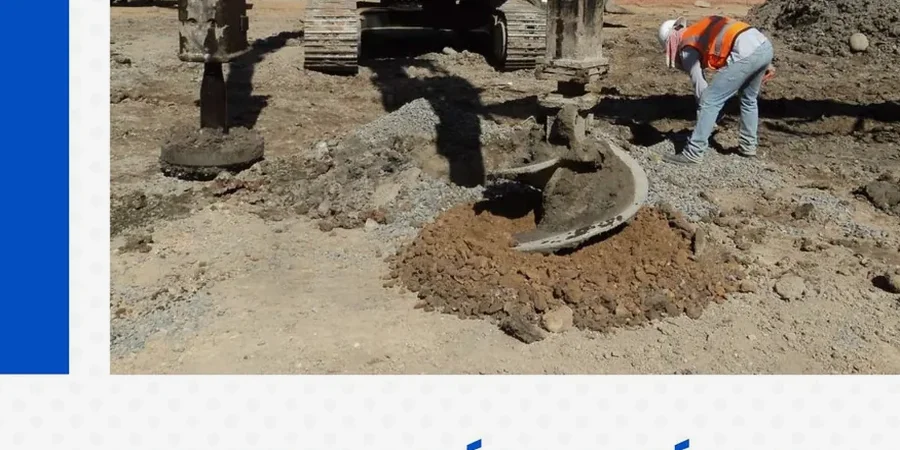
Regional considerations
The contrast between Brantford’s north-end till plains and the downtown river corridor is stark. On the north side, glacial till at shallow depth supports conventional spread footings with minimal settlement. Move south towards the river—Icomm Drive, Mohawk Street, the area around Wilfrid Laurier University’s Brantford campus—and you encounter 10-plus meters of compressible organic silt interbedded with sand lenses. A foundation designed without ground improvement in that zone can settle 50 to 80 millimeters differentially within the first two years, cracking partition walls and binding door frames. Stone columns reduce that differential movement by creating a stiffened mass that bridges the erratic pockets. But the design must account for the Grand River’s seasonal fluctuations: column tips need to penetrate below the zone of moisture variation to maintain stiffness year-round. Ignoring the river’s influence—especially during spring freshet when groundwater rises sharply—leads to underestimating the required column length and overestimating the long-term modulus of the treated ground.
Reference standards
ASTM D4719 – Standard Test Method for Prebored Pressuremeter Testing in Soils (modulus control for stone columns), NBCC 2015 – National Building Code of Canada (foundation design criteria), OPSS 1010 – Ontario Provincial Standard Specification for Aggregates (stone gradation)
Complementary services
Vibro-Replacement Stone Columns
Design and installation of bottom-feed stone columns for bearing capacity improvement and settlement control in Brantford’s soft clay and silt deposits. We handle layout optimization, aggregate specification, and ASTM D4719 modulus acceptance testing.
Pre- and Post-Treatment CPT Verification
Cone penetration testing before and after column installation to quantify improvement in tip resistance and friction ratio. Essential for validating design assumptions on Brantford’s variable alluvial profiles.
Typical parameters
Questions and answers
How much does stone column design and installation cost in Brantford?
Typical budgets for a Brantford project range between CA$1,880 and CA$7,920 for the design phase, depending on the treated area and number of modulus verification tests required. Installation costs are quoted separately based on column length and grid density.
What soil conditions in Brantford make stone columns necessary?
The Grand River floodplain contains thick deposits of soft clay and loose silt with undrained shear strengths below 40 kPa. These soils settle excessively under structural loads, and stone columns create a composite ground mass that limits total and differential settlement.
How do you verify that the stone columns are working correctly?
We run pre- and post-treatment CPT soundings between columns to compare tip resistance and friction ratio. Additionally, modulus tests following ASTM D4719 on selected trial columns confirm the design stiffness target before production installation proceeds.
Can stone columns be installed when the water table is high?
Yes. In Brantford the water table is often 2 meters below grade. We use bottom-feed vibroflots that deliver stone through the vibrator tip, keeping the hole open and preventing collapse. This method works reliably in saturated conditions without temporary casing.
How much settlement reduction can I expect with stone columns?
Based on Priebe method calculations and post-treatment CPT data from Brantford sites, we typically achieve a settlement reduction factor between 0.3 and 0.5, meaning total settlement drops by 50 to 70 percent compared to untreated ground.