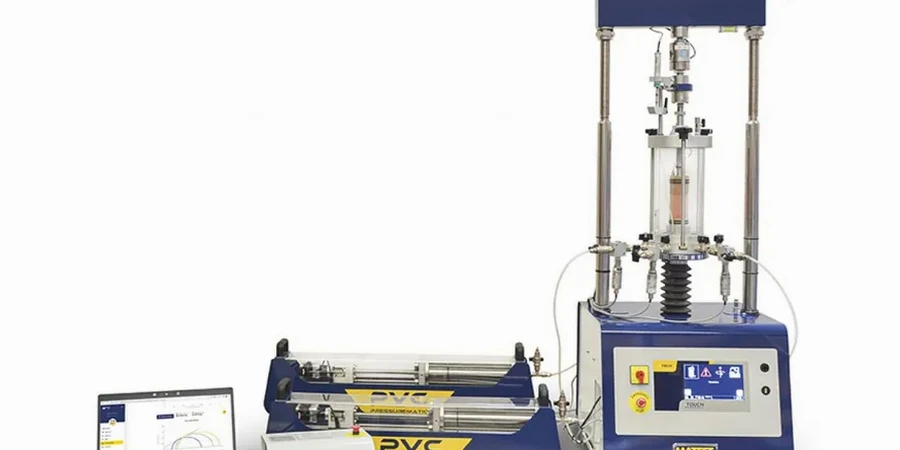
The triaxial cell sits inside a pressure chamber at our lab — a cylindrical soil specimen sheathed in a rubber membrane, subjected to controlled confining pressures that replicate in-situ stress at depth. In Brantford, where the overburden above the Salina Formation bedrock includes glaciolacustrine clays and silty tills, the drained and undrained behavior measured through this apparatus becomes critical for any deep excavation or slope adjacent to the Grand River. A single consolidated-undrained test with pore pressure measurement reveals more about a Brantford clay's effective stress path than a dozen simpler index tests. We run the triaxial frame under ASTM D4767 protocols, saturating specimens with back pressure until Skempton's B exceeds 0.95, then shearing at rates slow enough to allow pore pressure equalization across the specimen height — typically 0.01 to 0.05 mm per minute for fine-grained soils from the Haldimand clay plain.
Effective stress parameters from a well-executed triaxial program eliminate the conservatism of total-stress assumptions — often reducing foundation costs by 15 to 25 percent on Brantford clay sites.
Process and scope
Regional considerations
Winter freeze-thaw cycles in Brantford penetrate 1.2 to 1.5 meters into exposed clay subgrades, altering the fabric and preconsolidation signature that triaxial testing is meant to characterize. Samples collected between December and March from near-surface depths often show fissuring and increased permeability that masks the true undrained behavior — a seasonal bias that must be accounted for during interpretation. The Grand River's flood regime adds a second layer of complexity: riverbank soils experience cyclic wetting and drawdown, shifting between drained and undrained conditions within a single season. A CU triaxial with pore pressure measurement captures the transition point where positive excess pore pressure triggers strength loss, but only if the specimen is consolidated to the correct stress history. Misjudging the preconsolidation pressure by even 20 kPa shifts the interpreted friction angle enough to affect slope factor-of-safety calculations by 10 percent or more.
Reference standards
ASTM D4767-11 (Consolidated Undrained Triaxial Compression Test for Cohesive Soils), ASTM D2850-15 (Unconsolidated Undrained Triaxial Compression Test), ASTM D7181-20 (Consolidated Drained Triaxial Compression Test), NBCC 2020 (National Building Code of Canada — geotechnical design references), CSA A23.3 (Design of Concrete Structures — foundation provisions)
Complementary services
Consolidated Undrained Triaxial with Pore Pressure (CU)
Specimens saturated under back pressure, isotropically consolidated to estimated in-situ effective stress, then sheared undrained at controlled strain rate. We record deviator stress, axial strain, and excess pore pressure continuously. Output includes total and effective stress Mohr circles, c' and φ', and Skempton's A at failure. Essential for Brantford clay sites where rapid loading during construction generates excess pore pressure that dissipates slowly — the effective stress envelope predicts long-term stability that total-stress analysis misses.
Unconsolidated Undrained Triaxial (UU) Plus Remolded Strength
For preliminary assessment of fine-grained fill and residual soils common in Brantford's older industrial parcels, the UU test provides undrained shear strength Su without the time required for saturation and consolidation. We also run remolded specimens at field moisture and density when undisturbed sampling is impractical — the remolded strength ratio (sensitivity) indicates whether the soil loses significant strength upon disturbance, a key input for pile driveability and excavation support design in the Haldimand clay.
Typical parameters
Questions and answers
What's the difference between CU and CD triaxial tests for Brantford clay design?
The CU test shears the specimen undrained while measuring pore pressure, giving both total and effective stress parameters from a single specimen. It's the standard for Brantford's low-permeability glaciolacustrine clays. The CD test shears slowly enough to allow full drainage — no excess pore pressure develops — so it directly yields effective stress parameters. CD tests are appropriate for free-draining silts and sands, or when analyzing long-term drained conditions. For most Brantford clay projects, CU with pore pressure measurement is more practical because true drained shearing of clay can take weeks per specimen.
How many triaxial specimens do I need for a Brantford building foundation?
For a typical commercial or light industrial building on Brantford clay, we recommend a minimum of three CU triaxial tests per distinct soil unit identified in the borehole log. That means if your site has 2 meters of silty clay fill over 5 meters of intact glaciolacustrine clay, you'll want at least three specimens from the fill zone and three from the intact clay, each consolidated to different confining pressures to define the failure envelope. For single-family residential footings where risk is lower, one set of three specimens from the bearing stratum often suffices.
What does triaxial testing cost in the Brantford area?
Triaxial test pricing in Brantford typically ranges from CA$2,590 to CA$4,160 per set of three specimens, depending on test type (UU being the most economical, CU with pore pressure measurement at the upper end) and specimen preparation requirements. Undisturbed Shelby tube samples add collection and transport costs. Remolded specimens reduce sampling expense but require careful reconstitution to field density. A complete triaxial program for a mid-size commercial project — including sampling coordination, three CU test sets, and an interpretive report — generally falls within this range.
How long does a triaxial test program take from sampling to report?
From the day samples arrive at the lab, expect 10 to 14 working days for a standard CU triaxial program of three specimens. Saturation and consolidation phases each take 24 to 72 hours depending on soil permeability — Brantford clays are slow to saturate because of their low hydraulic conductivity. The shear phase runs 6 to 12 hours per specimen at the prescribed strain rate. If the project requires CD tests, add an additional 7 to 14 days because drained shearing must proceed slowly enough to prevent pore pressure buildup. We provide preliminary parameters within 5 working days when scheduling is critical, with the full interpretive report following. More info.