We see it every year. A small crew sinks a spread footing near Hardy Road, hits a pocket of saturated silt at 2 meters, and the excavation walls start slumping before the rebar cage goes in. The real mistake wasn't the dig or the weather. It was skipping the subsurface investigation because the neighboring lot "looked fine." Brantford sits on a complicated layering of Port Stanley Till over Devonian limestone, and the Grand River has deposited soft lenses of lacustrine clay and organic silt across the valley that don't announce themselves at the surface. A proper Standard Penetration Test program—rig-mounted, with split-spoon sampling per ASTM D1586—gives you the N-value profile that separates competent till from the weak zones that need over-excavation or a mat foundation design. Without those blow counts, you're guessing where the bearing stratum actually starts.
An SPT N-value of 4 in Brantford's Grand River silts versus N=35 in the Port Stanley Till—same city, completely different foundation design.
Process and scope
Regional considerations
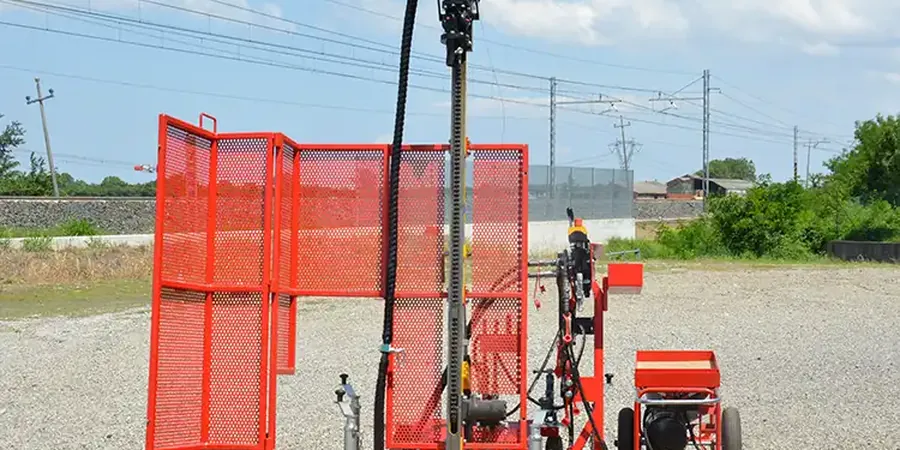
The rig we mobilize for SPT work in Brantford is a truck-mounted CME-55 with hollow-stem auger capability, and it's the right tool for the glacial stratigraphy here. The biggest operational risk on a Brantford borehole isn't hitting refusal on limestone—that actually gives you a clean bearing endpoint. The problem is the transition zone right above the bedrock surface, where decomposed shale and weathered limestone fragments create a gravelly, unstable interval that can collapse the borehole wall before the sampler reaches target depth. We've had projects near the old Cockshutt Plow factory lands where artesian conditions in fractured bedrock pushed groundwater up through the auger flights, complicating SPT blow count interpretation. In those cases we switch to mud rotary drilling and pair the SPT data with CPT soundings to get a continuous tip resistance profile through the disturbed zone. The N-value correction for overburden pressure becomes critical in these deeper boreholes, and we apply the Liao-Whitman method consistently so the geotechnical engineer gets numbers that reflect true relative density, not a depth artifact.
Reference standards
ASTM D1586-18 (Standard Test Method for Standard Penetration Test and Split-Barrel Sampling of Soils), NBCC 2015 (National Building Code of Canada, geotechnical provisions), CSA A23.3-14 (Design of concrete structures, foundation requirements)
Complementary services
Field SPT Drilling and Sampling
Truck-mounted CME-55 rig with automatic trip hammer, hollow-stem auger advancement, and split-spoon sampling at continuous 1.5 m intervals. Includes real-time N-value logging, recovery measurement, and sample preservation for lab testing.
N60 Energy Correction and SPT-Based Soil Classification
Conversion of raw N-values to N60 using hammer energy calibration and rod length/borehole diameter corrections. Soil description per ASTM D2488 from recovered samples, with pocket penetrometer and torvane data.
Bearing Capacity and Liquefaction Screening
SPT N60 data processed for NBCC allowable bearing pressure, settlement estimates, and seismic soil class per NBCC Table 4.1.8.4.A. Liquefaction screening using NCEER/Youd-Idriss method for saturated silts below groundwater.
Typical parameters
Questions and answers
How much does an SPT investigation cost for a typical Brantford residential lot?
For a standard single-family residential site in Brantford, an SPT program with two boreholes to 6 m depth typically ranges from CA$660 to CA$930. The final cost depends on access conditions, number of boreholes, depth, and whether we need mud rotary drilling for caving soils or bedrock coring.
How deep do SPT boreholes need to go in Brantford's glacial till?
NBCC 2015 requires investigation depth to extend through all compressible layers or to a depth where the stress increase from the foundation is less than 10% of the existing overburden pressure. In Brantford's Port Stanley Till, that typically means 6 m to 10 m for a two-story residential footing. On Grand River floodplain sites with soft silts, we often go to 15 m or until we hit competent till or bedrock.
What's the difference between raw N-values and N60 in your SPT reports?
Raw N-values are the blow counts recorded in the field without any corrections. N60 is the corrected value normalized to 60% hammer energy efficiency, which accounts for the hammer type, rod length, sampler configuration, and borehole diameter. Our reports present both, but the geotechnical design calculations for bearing capacity and liquefaction use N60 per ASTM D1586 and NBCC 2015.